Profile picture preview

PodMonthly

@PodMonthly

About Me
Highlights from podcasts - at least one a month.

Posts by PodMonthly

  • “The big change over the last year was going from chat-based where AI tells you what ti do to agent based where AI just does it for you”
  • “At a lot of companies roles are very strictly defined. But jobs are kinda fake delineations at times and you can just do things”
  • “Trading is like boxing. You have an opponent - the market. You’re feeling each other out, gathering information, trying to do well enough, and every now and then you’ll see an opening for a knockout, an opportunity for a major investment win.”
  • “I love to find peak Spring and peak Fall. You can find that day in a neighborhood. And in peak Spring, when the colors are vibrant and the fragrance is just overwhelming, I’ve never felt so alive in my life. And I’ll look for that. I travel the US for that moment because I know when peak Spring is in Georgia, I know where peak spring is in Tennessee, and I know where it is in New York City. Same thing in the Fall where you see those great color changes by day, by tree. And you find that day with that intersection of color change, you can feel the energy. I’ve never felt so alive in my life. It’s such a wondrous moment how you go through how life is changing so fast. Those days are so energetic and so exciting and I highly recommend people try to in their neighborhood find that day, boy, make sure you’re walking that afternoon before sunset. Oh my gosh, it’s a joy.”
  • Definition of an engineer: “an engineer is someone who obsoletes themselves from everything they do”
  • “Your goal when you’re in your 30s and 40s is to equally disappoint everyone in your life:
    • Wife
    • Kids
    • Parents
    • Health 
    • Work
    • Friends
    • Retirement account”

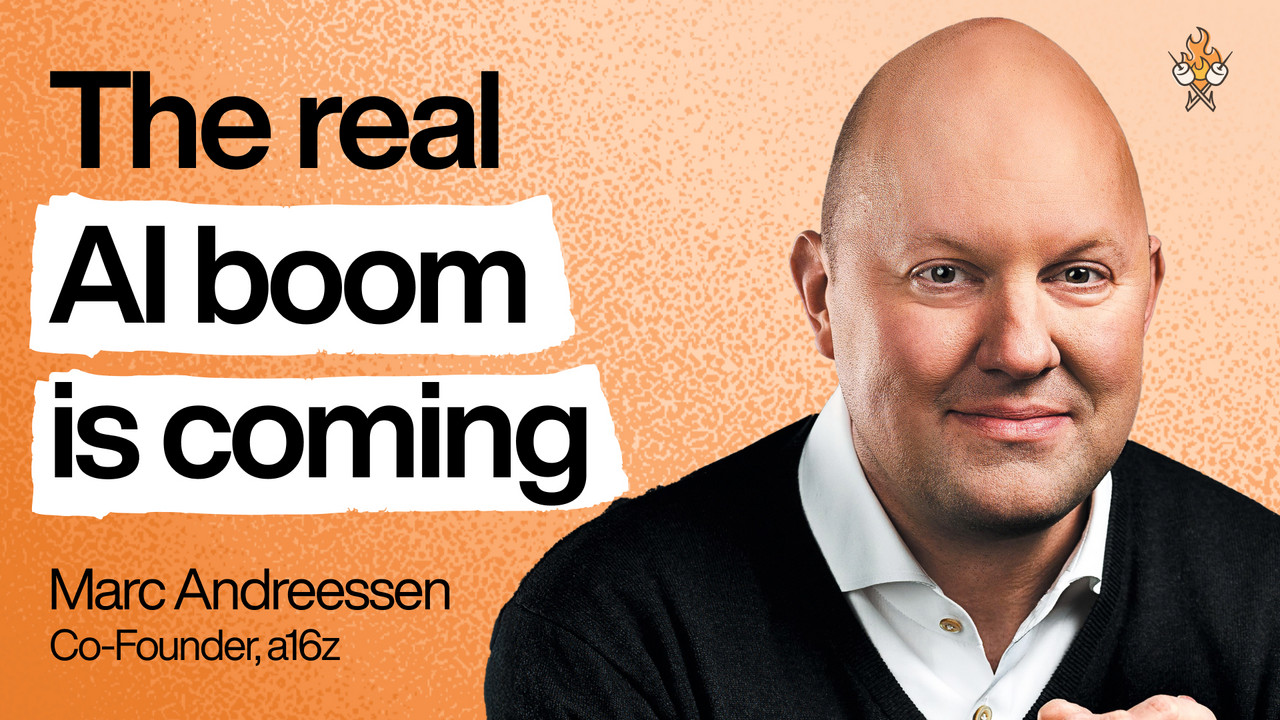
Marc Andreesen did a round of podcasts recently (Lenny's podcast, 20 minute VC, conversation with Founders podcast) - here were the top few highlights for me from the co-founder of Netscape and a16z:

  1. "We’re living in a world where we don’t understand how good good can get cause we’ve been capped by our own biology. AI will be way better than the best human coder, doctor, lawyer, in many ways. It’s already at 130-140 IQ, humans max out around 160, and continuing to improve. The idea of human equivalency will be a quick footnote - what does the world look like when AI then becomes much better than that?"
  2. The craziest story: Marc was basically single handle tech support for the entire internet for 3 years in the mid 90s. Cause everyone used Netscape to use the Internet, so whenever anyone had trouble using the Internet in the early days they would send a help request and he was the one person who would answer.
  3. “1:1 Tutoring is the most proven way to improve education results, and now with AI everyone can have it”
  4. “In industry after industry there’s all these embedded assumptions that just don’t make sense anymore…these broken assumptions are where startups come from”

5 things I took away from the Founders podcast covering Roger Federer 

A core component of what made Federer so great for so long: the importance he placed on rest, work-life balance, and adjustments to enhance his sustainability when it came to tennis:

  • “Even when I was at my best, it was important  to me to have a rewarding life full of travel, culture, friendships, and family. These are the reasons that I never burned out.“
  • Federer's fitness coach: tough consistent work was necessary, but so was rest and escape. Dedication and moderation. Fresh legs were vital, feeling fresh in the head was vital. Rest and recovery weren’t a break from training, they’re a central part of the mechanics that makes training work
  • He likes to mix it up, keep himself from not getting bored. “I hadn’t been around somebody that had as much flexibility in their approach that Federer does. At Wimbledon, he’d stay in different houses. He doesn’t always need to practice in the same place, or javelin one favorite meal. Federer changed coaches even as a winner multiple times. This was a pattern throughout  his career. Federer said he felt they had fallen into a routine. This was a key element in Federer’s career longevity. Too much routine can kill the joy. Too much focus can grind you down. (Of the 128 men who played singles at the 1999 French open, he was the last one still playing on tour). RF: “I never fell out of love with the sport. Never”

Federer won 80% of the matches he played, but only 54% of the points - even the best players lose almost as much as they win 

  • A former coach: "the gap between the best tennis player in the world and number 4 is massive. The 200th best player in the world is closer to number 4, than number 4 is to number 3."
  • Federer, like Djokovic, believed that stagnation is regression. Maintaining the same level was actually losing ground
  • Built a team around him that held him to high standards. “You’re gonna doubt yourself enough. You can’t have other people around you doubting you. You have to run away from your naysayers.” Federer literally switches his dentist because he didn’t want to hear any negativity
  • Became great student of prior players. This is somebody who made it to Wimbledon semis in 1968. And this is somebody who won doubles in 1954

Life advice from Kevin Kelly:

  • "Enthusiasm is worth 25 IQ points."
  • "To make something good just do it. To make something great just redo it, redo it, redo it. The secret to making fine things is in remaking them."

Music producer Rick Rubin:

  • “Do you know the biggest mistake most musicians make? Their first album comes from love, heartbreak, passion, or depression. They have no expectation of how the world will respond. They write it from the heart, and if it catches on, they’re validated by the world. But then they start writing their second album, and they don’t necessarily write it based on love, heartbreak, or passion. They write the album they think the world will want…When making art, the audience comes last.”
  • "Rules direct us to average behaviors. If aiming to make something exceptional, most rules don’t apply. If anything the goal is to amplify your differences. Communicate your singular perspective."

After learning about Panera, I wanted to learn more about some of its fellow fast casual competitors - the leaders that impact directly and indirectly what many of us eat every day. 

I listened to the founders of Chipotle, Cava, and Sweetgreen tell their stories on “How I Built This”. The top takeaways:

1. Start Small

  • First store for Chipotle was only 800 sq feet
  • First store for Sweetgreen was only 500 sq ft (this was too small and they had to rent adjacent parking spaces for more storage) and they were a DC-only brand for over 5 years which helped them tinker with and prove out the model
  • First store for Cava spent just $15k on an old space

2. Find Your Niche

  • Healthy Mediterranean: Cava dropped things early on that sold well but weren’t Mediterranean like pimento cheese and chicken salad
  • Organic Local Salads/Bowls: Sweetgreen dropped soft serve to focus on a healthy brand. Focused on marketing to running clubs and fitness space given the connection between healthy salads and working out. 
  • Chipotle nailed this from the start, and then benefited from post-workout desires for protein (beans and meat).

Memorable Quotes from 2025 Guests on Shane Parrish’s The Knowledge Project

Harley Finkelstein (President of Shopify)

  • "The right entrepreneurs, the best entrepreneurs, they just simply out-care other people."
  • “Most people are not willing to look stupid for some period of time. Too many people are too apprehensive. I’ve long believed that getting really really comfortable with being uncomfortable is magic. You can’t be born with that, you learn it. I don’t know anyone who I admire who’s had success and not gone through that period of looking kind of dumb.”

Bret Taylor (founder of Sierra AI, prior creator of Google Maps, CTO Facebook, co-CEO Salesforce, chairman Twitter, board member OpenAI)

  • “What will the role of software engineering become as we go from authors of code to operators of code generating machines?”
  • “AI is causing really rapid transformation (software engineering, the law, marketing, customer service, etc). If you’re not responding to the facts in front of you and thinking from first principles then the likelihood you’ll make the right decision is almost zero. For example in our AI customer service business, our pricing model only charges our customers for the outcomes (rather than use) given AI can complete a task rather than just help you be more productive. And we work with our customers to deliver more fully configured software for them, because in a world where making software is easier than it ever was before, the delivery model of software probably should change as well.”

Ron Shaich (Panera co-founder, Au Bon Pain co-founder, investor it Cava and Tatte)

  • Category design beats competition: Panera didn’t try to out-execute fast food companies, but helped invent the new category of "fast casual". Re-defining the game was more important than playing harder (“If you’re competing head-to-head, you’re already losing.”)
  • “The job of a leader is to see what others don’t - yet.” 

Highlights from four tech leaders (a16z, Slack, Spatial Computing, AI-powered deck creation) discussing good software design and the state of AI

Founder of Gamma ($100 ARR AI-powered slide deck software, started in 2020 now valued at $2 billion)

  • Insight that led to founding the company: “On Google slides I was spending 80% of time on the look and feeling, 20% of time on content. It should be backwards.” Paul Graham commented “surely the thing that the slide deck is describing is more valuable than the slide itself.” 
  • Emphasized the importance of making the first 30 seconds of the product incredible - was the key factor leading to product viral growth and product-market fit.

Marc Andreesen (a leading VC and former entrepreneur):

  • "AI is the first monumental rearchitecture of what is a computer in 80 years."
  • "The scenario where you have only a few big AI model winners is like if we just had mainframes instead of desktop and laptop and mobile and watch. It would mean basically the top AI models are the best across many things, and cheapest, and most power efficient, and fastest, and easiest to adopt and use for every scenario. And we are going to want AI infused in everything."

Founder of World Labs (Fei Fei Li, a major contributor to AI progress who is focusing on developing AI models that are spatially rather than linguistically intelligent):

  • "So much of our intelligence is built upon visual perceptual spatial understanding. Not just language (the foundation for LLM models powering the current wave of AI). I think they are complimentary."
  • Use cases for spatial models include: robots, disaster support like putting out a fire ("words alone aren’t enough"), gaming, scientific discoveries (DNA required 3d visualization)
  • "Robots are more like self driving cars than LLMs. 20 years from self driving in desert to in the streets, and we’re not even done yet. And self driving cars are much simpler robots - they’re just metal boxes running on 2d surfaces, and the goal is not to touch anything. Robots are 3d things moving in the 3d world and the goal is to touch things."

Slack Founder on good software design:

  • "Good software is less about reducing friction and more about reducing people feeling dumb or having to think when using your software.”
  • On tilting your umbrella to let someone else go by more easily: “Bezos famously said ‘your margin is my opportunity’. At Slack we said ‘your non-umbrella tilt is my opportunity’. Your failure to really be considerate and empathetic about other people’s experience can be our critical advantage. Slack wouldn’t have grown the way it did without those little conveniences. ‘Tilt your umbrella’ is still on company swag.”